Who It's For
Clarity is built for organizations that carry two jobs at once. There is the human job: a person in front of a case manager, a need that has to be met today. And there is the accountability job: funders who want outcomes, auditors who want a trail, regulators who want protected data kept protected. Nonprofits, NGOs, and multi-agency programs live at that intersection, and most of them meet it with a stack of disconnected tools, an intake form here, a shared drive there, a separate system for the grant report, and a lot of re-keying in between.
Clarity collapses that stack into one governed platform. A case enters once and stays current everywhere: the field worker's quick mobile entry, the case manager's longitudinal record, the finance team's ledger, and the report owed to a funder at quarter-end. Nothing gets copied between systems by hand, so nothing drifts out of sync. That is the whole premise. The features below are how it holds up.
The Hub: Clarity Core
Every organization starts on the same Clarity Core. It is the central case-management hub and the single place every record, form, and transaction lives. The Core does not change from one customer to the next, which matters more than it sounds, because it means the security model, the reporting model, and the data model are the same underneath every program. You are not maintaining a different system per organization. You are configuring one.
Inside the Core, Four Things Do Most of The Day-to-Day Work:
Long-term case tracking. The record is longitudinal, not a snapshot. A case manager can see what changed for a client over months, not just the last contact, which is exactly the view a funder asks for and the view a spreadsheet can never reconstruct after the fact.
A dynamic form builder. This is the feature that keeps the platform from becoming a custom-software project. An org admin builds and deploys a new intake form without waiting on an engineer. Different programs ask different intake questions, owe different funders different things, and run different field workflows. The form builder is how all of that variety lives in configuration on top of the Core instead of in a fork of the codebase.
A global transactions view. Every financial and resource exchange consolidates into one ledger. Instead of reconciling money and services across separate tools, a finance lead sees the whole picture in one place, tied to the same records the case managers are working from.
A conversion engine. An intake or a referral becomes a full client profile in a click. The point of entry does not become a dead end that someone has to re-key later; it promotes straight into the live record.
The Spokes: Modules
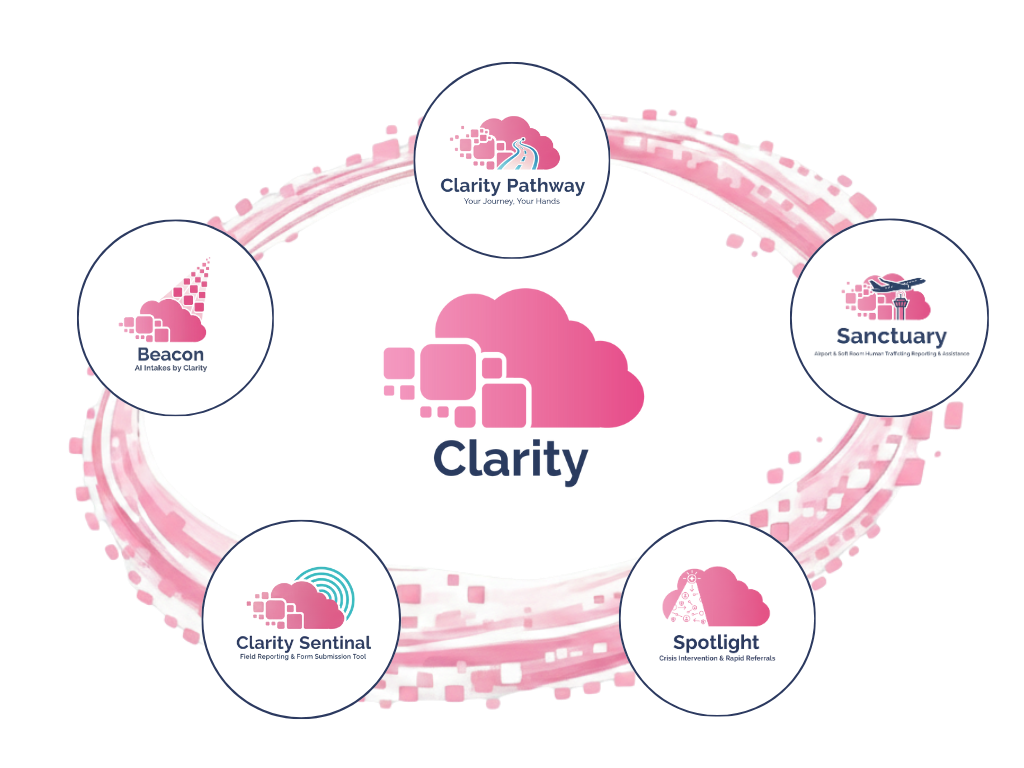
Around the Core sit the modules: lightweight, task-specific interfaces for teams who need speed over a full backend. A field worker does not need, and should not be handed, the entire system. They need a simple mobile tool sized for a ten-minute task, and Clarity gives them exactly that. The modules are learnable in about fifteen minutes, and every entry syncs straight back to the Core.
This is also where the pricing model earns its keep. A field worker on a roughly $10 module license and a case manager on a roughly $30 Core seat are looking at the same underlying record, the field tool is just a smaller window onto it. An organization does not pay for full seats it does not need, and it does not buy a second system to give field staff something lightweight. One record, two windows, two price points.
The Part Most Demos Skip: Governance
It is tempting to judge a platform by its feature list. The honest version is that for human-services data, the features are the easy part. The hard part is governance, keeping the right people able to see the right data and everyone else out, while the work still moves fast enough to be useful in the field. Clarity treats that as a first-class feature, not a settings page:
Role- and license-based access. A field worker sees what their role permits. A case manager sees the longitudinal record. An admin configures the system. None of them see past their boundary.
Separation of sensitive data. The most sensitive categories, such as referral records, sit separate from the main client database rather than mixed into it. Sensitivity is a structural decision, not a checkbox.
De-identified coordination. When organizations need to collaborate on a shared concern, coordination can run on de-identified data, so two agencies work together without either one over-sharing.
An audit trail. Access is logged. In this domain, "who saw what, when" is not a nice-to-have; it is the thing that lets an auditor accept the system and lets a regulated organization put real records into it.
None of this shows up in a flashy demo. All of it is what makes the platform usable for real.
Reporting That is Already Done
The last feature is the one teams feel most. For most organizations, the grant report is a separate, dreaded exercise: reconstruct months of work from scattered notes, count service units by hand, and hope the numbers tie out before the deadline. Clarity is built so the report is a roll-up, not a reconstruction. Service units, assessment completion, and outcome trends accumulate in the Core as the work happens. When the report is due, the data is already there, entered once, at the moment of the work. Time a case manager does not spend rebuilding a report is time spent with a person. That is the argument for the platform, stated as plainly as it goes.
The Shape of It
Put together, the feature set is a hub and spoke: a secure, compliant Core that does the heavy lifting, modules that put a fast, focused tool in a field worker's hand, a form builder that lets each program shape its own intake, governance that an auditor accepts, and reporting that is finished when the work is finished. Built the hard part once, governed properly, so every program can shape the rest.
If your organization is running its case management out of spreadsheets and disconnected tools, and the grant report is a quarter-end fire drill, that is the problem Clarity was built for. A 30-minute walkthrough is usually enough to tell whether it fits.