If you’re a CIO, a COO, or the person who drew the short straw and had to write your company’s AI policy, you probably already have something on paper. An acceptable-use policy. A list of sanctioned tools. A line telling employees not to paste member, patient, or customer data into a public chatbot.
That works for people typing into an assistant. It says nothing about an agent that reprices a loan file, updates a vendor record, or routes a case to a caseworker at 3 a.m. with nobody watching.
At PRR, we build AI platforms in environments where getting this wrong is not an option: credit unions and lenders answering to examiners, federal and state human services programs handling some of the most sensitive data there is, and data center operators running regulated, safety-critical infrastructure. What we’ve learned is simple. Once AI starts taking actions, governance stops being a document and becomes architecture.
This post covers what most organizations have today, the six controls we put in place before any agent touches a system of record, and how we sequence them using our Stabilize, Optimize, Transform approach.
What most organizations have today
Most mid-market and enterprise teams we meet have four things: a policy PDF written when they rolled out Copilot or ChatGPT Enterprise, a cross-functional AI committee, an approved-tools list, and a security review for new AI vendors.
Now ask three questions. Which agents are running in your environment right now? Who owns each one? What systems can each one write to? In our experience, the honest answer is usually a pause, then a promise to follow up.
That gap exists because the first wave of AI governance was built for assistants — tools a person prompts. The risk there is data leaking out. Agents are a different animal. They live inside your systems of record and act on your behalf, pulling people in only for exceptions. The risk is what they do, not what they see.
How agent sprawl happens
The pattern is predictable. A sharp analyst in lending ops or finance wires up an agent using their own API key and a service account they already had. It works. Word spreads. Within a quarter, several teams have their own versions — different keys, different prompts, different logic, charged to different cost centers and corporate cards.
Then an examiner, auditor, or program officer asks who changed a record and why. Nobody can say which agent acted, which prompt version it ran, whether a human approved it, or who is paying for it. That’s agent sprawl, and it is now one of the most common problems we’re brought in to untangle.
Governance is identity, permissions, decisions, and evidence
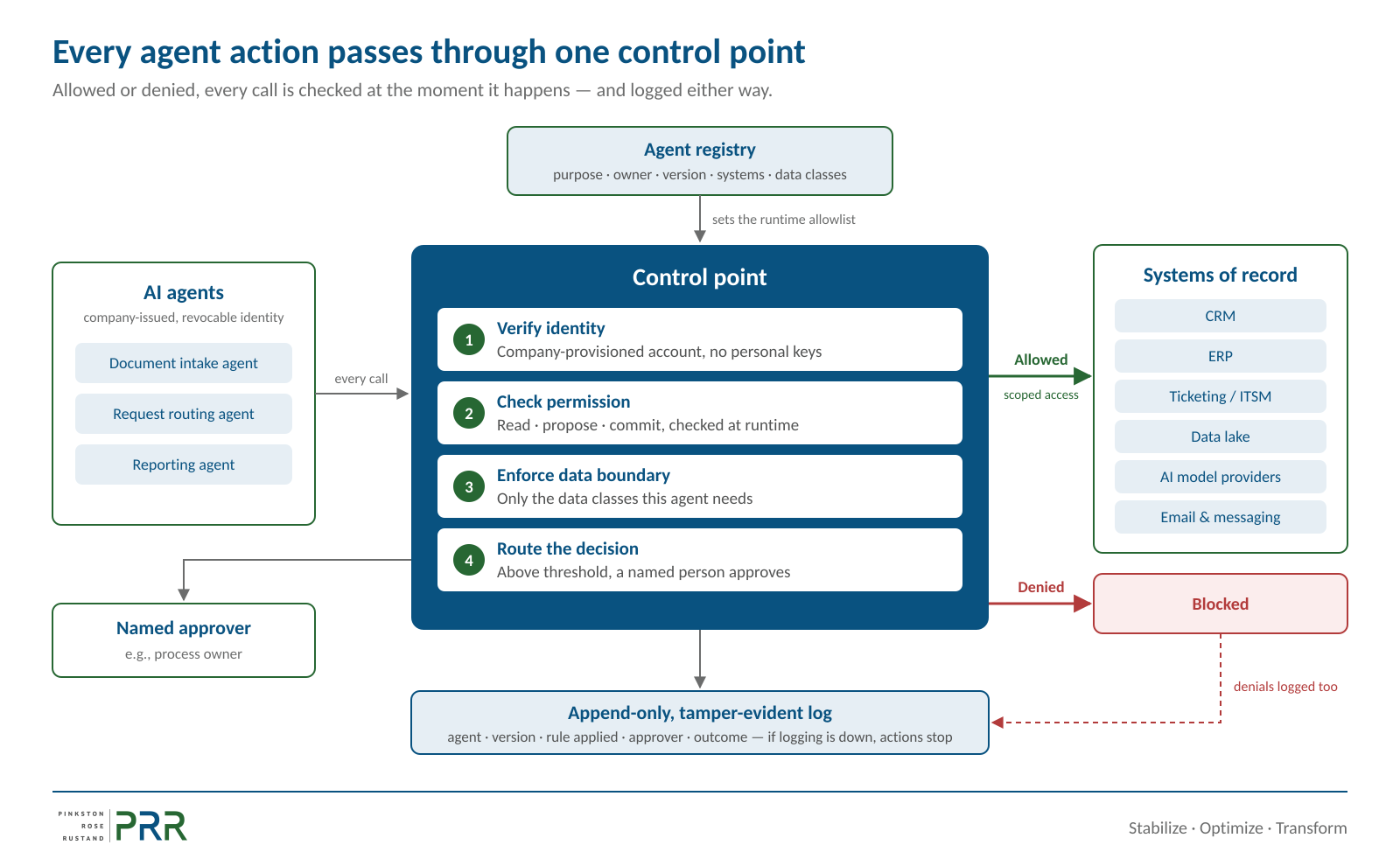
Strip it down and AI governance answers four questions: Who is the agent acting as? What can it touch? Who decides what it’s allowed to do? What proof exists afterward? Once agents act, every one of those answers lives in your identity provider, your permission model, your workflow design, and your logs. The policy should describe those controls — not substitute for them.
These are the six controls we require before an agent writes to anything:
- Company-issued identity. Every agent runs under an account your organization provisions and can revoke instantly. No personal keys, no borrowed admin credentials. Access starts read-only and expands only to an agreed scope.
- Read, propose, commit — checked every time. Reading data, proposing a change, and committing a change are three separate permissions. Each is granted by an accountable admin, and each is checked at the moment of the action, not once at startup.
- Data boundaries by classification. Each agent is scoped to the data classes it actually needs. In our human services work, that means personally identifiable and case-level data stays separated from de-identified research data by design, not by good intentions. In lending, it means member financials stay inside the workflow that needs them.
- A named human for every decision type. Before we build, we map every action the agent can take and decide which ones it handles alone and which require a person. Not a team — a person. For example: the lending manager approves any change to a borrower’s payment terms above a set threshold. Most of the volume goes to the agent; the judgment calls go to someone with a name.
- One registry. Every agent is recorded in a single place: its purpose, owner, users, systems touched, data classes, and current version. If it isn’t in the registry, it doesn’t run.
- An append-only log that includes the “no’s.” Every action is written to a tamper-evident log — including actions the agent attempted and was denied. Denials are gold: they show you where the agent’s idea of the process differs from yours. And if logging is down, actions stop.
In practice, every call an agent makes — to a model, an ERP, a core banking system, a case management platform, an email server, a secrets vault — passes through a single control point. That point checks a runtime allowlist for that agent in that environment, hands out narrowly scoped access if the action is allowed, blocks it if not, and logs the outcome either way. Change the allowlist and the very next action reflects it. That is what lets Risk, Compliance, and IT sign off with confidence instead of crossed fingers.
Stabilize, Optimize, Transform: the first 90 days
Every PRR engagement follows the same arc — stabilize what exists, optimize one workflow, then transform how the organization runs. Agent governance is no different. Expect roughly 60 to 90 days to get the first function into production.
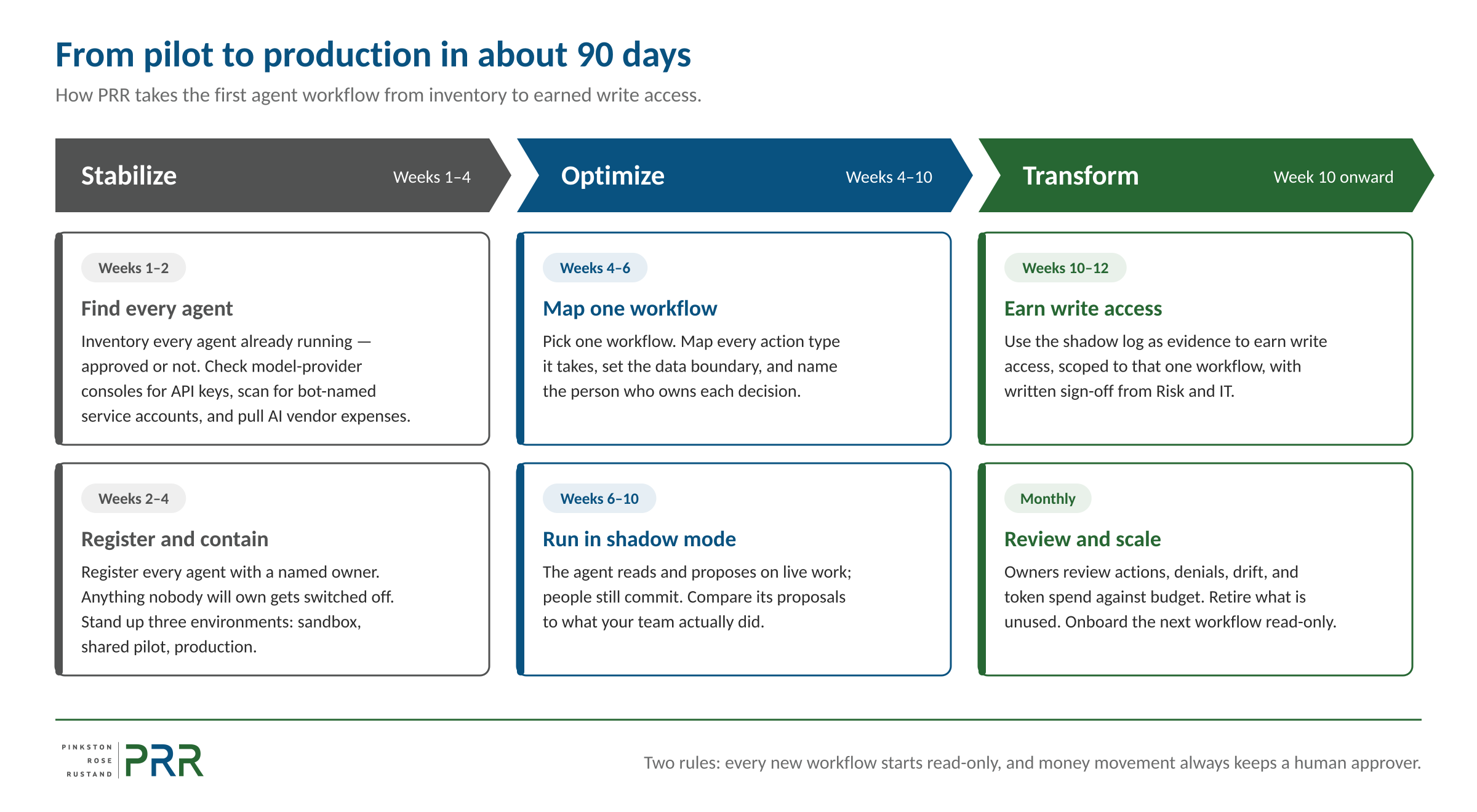
Two rules we hold everywhere. First, every new workflow starts with zero write access, no matter how well the last one went. Second, anything that moves money keeps a human approval step. The labor saved by automating that final click will never outweigh the one time it goes wrong.
What it looks like in a lending workflow
Take a credit union service organization reviewing SBA loan files. The pressure is the same everywhere: more volume, same headcount, an examiner who wants to see every decision.
The agent starts in a sandbox with temporary credentials and a copy of last quarter’s files. Once more than one team wants it, it becomes a real workflow: one agent, one maintained prompt, one process owner. It then runs in shadow mode on live files, extracting documents, checking eligibility, and flagging gaps, while underwriters still make every call. The log shows exactly where its judgment diverged from theirs.
After a few weeks of evidence, it earns write access — limited to that workflow, limited to the fields it needs, and routing anything above a defined threshold to the credit manager for approval.
The before and after:
- Agents: several unsanctioned copies become one owned, versioned agent.
- Accountability: nobody becomes a named owner plus named approvers.
- Access: personal keys on personal cards become one corporate identity you can shut off.
- Audit: a multi-week investigation into “who changed this?” becomes a log search that shows the agent, the version, the rule that allowed it, and the person who approved it — in minutes.
Why so few organizations get this right
Committees are comfortable. No one has to own the outcome. But the agent layer doesn’t belong to any single function. IT owns identity, Security owns vendors, Finance owns the ERP, Operations owns the process — and the wiring that connects them belongs to no one, so it never gets built.
Point solutions make it worse. Buy agents from a dozen vendors for sales, accounting, and the help desk, and you get a dozen consoles with a dozen permission models and a dozen log formats. That’s sprawl with a purchase order.
And a large-firm governance framework — the maturity model, the RACI, the target operating model — won’t help when an examiner asks a direct question and expects an answer in seconds, not a follow-up email next week.
Governance is how you go faster
Here’s the part most people miss: get the foundation right and you can say yes to far more AI, not less. The best agent ideas come from the people closest to the work — the loan officer, the caseworker, the site engineer. Let them build. Just don’t let them build the infrastructure their agents run on. That has to be shared, and once it is, you can be far more permissive in the sandbox because the guardrails are real.
How PRR helps
This is what we do. PRR designs, builds, and operationalizes AI platforms inside your cloud, connected to your systems of record, under your control. You provision the identities. Permissions are checked at the point of action. You decide who approves what. You get one registry, versioning, evaluations, and an append-only log that includes denials. You own the platform, and you can turn any of it off at any time.
A typical starting engagement: we inventory and map one function, then take its first workflow from shadow mode to production. We do this for financial institutions, federal and state health and human services programs, and enterprise operators.
If you’re the person who has to answer “who changed this, and why?” — let’s talk.